Friday, November 13, 2009

Arthrogryposis Multiplex Congenita


    Arthrogryposis Multiplex Congenita

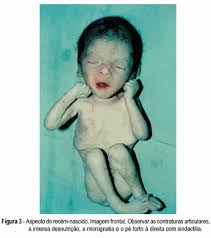
    Arthrogryposis multiplex congenita (AMC) is a nonprogressive neuromuscular disorder present birth that is characterized by fibrous ankylosis (contractures) of multiple joints. Muscle development is arrested at some time during the fetal period and fibrous or fatty tissue replaces the muscle, resulting in contractures and abnormal joint surfaces. Types of AMC include neuropathic, myopathic, and mixed.

    Cause

    The cause of AMC is unknown. The disorder is not genetic; individuals have normal chromosomes. Some cases can be traced to neurogenic causes through histologic and electromyographic evidence, or to myopathic causes through studies of muscle fiber. Other causative agents may include prenatal exposure to adverse environmental agents, maternal infection, abnormal connective tissue, chromosomal or genetic defects, and impaired intrauterine fetal movement.

    Assessment

    Areas:

    • Range of motion.
    • Muscle strength.
    • Developmental of gross and fine motor skills.
    • Developmental of hand skills, grasp, and prehension
    • Balance and postural control
    • Self-perception
    • Family and social support
    • Daily living skills
    • Play skills

    Instruments:

    No specific instruments have been developed by occupational therapists to deal with this disorder. The following may be useful:

    · Developmental assessment

    · Activities of daily living scale

    · Play history

    Problems

    Motor:

    • The disorder is usually characterized by rigidity and/or contractures of the joints.Typically, in the upper extremities , the shoulders are adducted and internally rotated, the elbows are extended but occasionally flexed, the forearms are pronated, the wrists are flexed and ulnary deviated, the fingers are flexed, and the thumb is in the palm. In the lower extremities, the hips may be dislocated and are usually flexed and externally rotated, the knees are extended but occasionally flexed, and the feet are in equinovarus.
    • There is usually severely limited range of motion in all major joints.
    • Muscle weakness usually occurs.
    • The person may have absence or atrophy of individual muscle or muscle groups.
    • The person may ave gross abnormalities of the chest and spine (myopathic type).
    • Other problems include webbing on the ventral aspects of flexed joints, cleft palate, scoliosis, torticollis, facial palsy, limb deformity, and congenital amputation.
    • Achievement of gross and fine motor skills is usually delayed
    • Development of hand functions is usually delayed.

    Sensory

    Sensory system is intact, but perceptual skills, such as stereognosis, could be delayed due to lack of opportunity.

    Cognitive

    Cognition is normal and intelligence is average to above average, but learning could be delayed due to lack of opportunity and many surgical procedures.

    Intrapersonal

    • Parents, especially the mother, may feel guilt about having a handicapped child.
    • Child may have tantrums due to frustrations.

    Interpersonal

    Family members may reject the "funny looking" child and leave the parents or mother without support.

    Self-Care

    Development of self-care skills is usually delayed because the patient's hand functions and fine motor skills are now develop.

    Productivity

    Play skills are usually underdeveloped.

    Leisure

    See productivity.

    Treatment/Management

    Motor


    • Increase and maintain range of motion through activities, such as exercise and stretching.
    • Promote achievement of gross and fine motor skills.
    • Improve posture and positioning through the use of adapted equipment, such as corner seats, strollers, swivel buckets, or parapodiums.
    • Provide splints to maintain gains in range of motion or serial casts to increase range of motion.

    Sensory

    Provide opportunities to experience sensory input.

    Cognitive


    • Provide opportunities for learning and encourage child to explore problem-solving methods.
    • Provide information to parents about the disorder and encourage parental participation in the therapy program. They should understand the importance of having the child wear splints until bone matures and continuing range of motion activities everyday so the child maintains use his/her body
    • Provide information about community resources and services.
    • Provide information about normal growth and development.
    • Provide information about architectural and environmental barriers.
Intrapersonal

    • Provide opportunities to develop self-perception through the use of creative activities, such as art, crafts, drama, dance, music, and games.
    • Encourage parents to express feelings and concerns about the child's condition and welfare.
    • Provide instructions in stress-management techniques.
Interpersonal

    • Encourage parent-infant bonding.
    • Encourage parents to participate in self-help groups.

    Self-Care

    • Provide self-help devices to assist in the performance of daily living skills. A lazy susan may be used as a plate. Food can be placed around the edge of the plate.
    • Adapted equipment may be necessary for grooming, such as extended handles on combs, brushes and toothbrushes.
    • Clothing adaptation may be needed to account for various deformities, using Velcro and elastic. Providing large rings on zippers or loops to grasp and large button is also useful.

    Productivity

    • Promote development of play skills, especially exploratory and manipulative play.
    • Assist teachers in determining what, if any, adapted equipment or devices may be needed to assist a child with academic activities. Computers with adapted keyboards may be helpful. the child should be able to attend regular classroom instruction, except for physical education.

    Leisure

    Usually no special goals or objectives are necessary. The child or an adult will seek those activities that are within the child's functional abilities.

    Precautions

    Bone structure is fragile. Range of motion and stretching exercises should be carefully monitored.

    Prognosis/Outcome

    • The person has maximum range of motion possible given structural limitations.
    • The person achieves gross and fine motor skills, although the development of skills does not progress normally.
    • The person has functional hand skills, although the use of the hands may be unorthodox.
    • The person has independently mobility with or without powered mobility.
    • The person achieves independence in self-care and daily living skills.
    • The person develops productive skills.


Thursday, November 12, 2009

Kidney Disease with Dialysis


What is Kidney Disease with Dialysis?
Diseased kidneys are unable to maintain homeostatic balance of water, minerals, and excretion. Toxic end-products accumulate in the blood
and tissue. The kidney also is no longer able to function as an endocrine organ.Dialysis is the process of separating elements in a solution by
diffusion across a semipermeable membrane. The purpose is to reestablish homeostatic balance and decrease the toxic end-products.


Cause
Acute or chronic kidney failure may occur as a result of numerous disorders, including uremic encephalopathy, pericarditis, intractable
metabolic acidosis, congestive heart failure, and hyperkalemia. Persons affected may be of any age. Both sexes are affected equally.

Assessment

Areas
  • developmental profile
  • muscle strength
  • range of motion
  • endurance
  • fine motor skills, manipulations, dexterity, and bilateral coordination
  • sensory registration
  • sensory processing
  • attention span
  • learning skills
  • self-concept
  • sense of self-mastery or self-control
  • mood or affect, especially signs of depression
  • social skills
  • coping skills
  • daily living skills
  • productive history, values skills, and interests, including academic and play skills
  • leisure skills and interest

Instruments
No specific instruments developed by occupational therapists were identified in the literature. The following types of tests may be useful:
  • academic testing
  • manual muscle test by groups of muscle
  • goniometry
  • activities of daily living
  • play history
  • leisure checklist

Problems

Motor
  • The person may have decreased muscle strength.
  • The person may have decreased physical endurance and rapid fatigue.
  • The may have loss of range of motion.
  • The person may have decreased muscle control.
  • The person may have decreased fine motor coordination and dexterity.
  • The person may have foot drop, trmor, or other signs of peripheral neuropathy.

Sensory
  • Loss of sensation may occur.
  • Loss of vision or decreased visual acuity may occur.


Cognitive
  • The person may have loss of attention span and concentration.
  • The person may experience drowsiness.

Intrapersonal
  • The person usually experiences a decrease or loss of self-concept, especially mastery and autonomy.
  • The person may have lost self-esteem or feelings of self-worth.
  • The person may express anger and frustration.
  • The person may experience loss of effective coping skills.
  • The person may have an increased sense of dependency.
  • The person may be depressed.
  • The person may express fear of death.
  • The person may become irritable and uncooperative.
  • The person may become confused and anxious.
  • A preschool child may perceive painful medical procedures, hospitalization, and separation from parents as punishment.
  • A school-age child may perceive him or herself as different from others.
  • The parent or parents may have many of the same problems that the child experiences.

Interpersonal
  • The person may experience difficulty relating to authority figures.
  • the person may withdraw from social group interaction.
  • The person may experience conflict with his or her family related to changing roles.

Self-Care
The person may be unable to perform some activities of daily living due to limited energy or decreased range of motion.


Productivity
The person may be unable to perform productive activities, such as academic work, play, and chores, due to reduced energy level or decreased strength.


Leisure
The person may not engage in favorite leisure activities because of decreased functional abilities.


Treatment/Management

Motor
  • Increase muscle strength through graded activities.
  • Increase functional range of motion through selected activities within the person's normal activities if possible.
  • Increase the person's muscle control.
  • Increase coordination and dexterity through selected activities.
  • Increase physical endurance through gentle exercises.


Sensory
No specific sensory treatment or management is recommended.


Cognitive
  • Instruct the person in concepts of energy conservation and work simplification.
  • Instruct the person in concepts of safety associated with dialysis.
  • Assist in instructing the person on recommended diet changes and necessary modifications in food preparation.
  • Instruct the person in development of a time-management schedule that includes cycles of rest and exercise.
  • Select projects that are quick and require a short attention span, such as games, puzzles, mazes, or crosswords for children.


Intrapersonal
  • Increase self-concept through successful accomplishment of art, craft, educational, creative writing, or game activities.
  • Increase the person's sense of mastery through knowledge about and performance of activities.
  • Encourage the person and family members to verbalize feelings of hopelessness, helplessness, and fear of dying.


Interpersonal
  • Encourage the person to engage in social activities.
  • Assist the person and family to reorganize roles within the family unit, if necessary.
  • Encourage the person and family to articipate in a self-help group, if available, in their hospital or community.
  • Encourage the person to maintain contact with the outside world if hospitalization is required. Field trips may be useful.

Self-Care
  • Maintain or increase independence in self-care activities through the use of work-simplification or time management techniques.
  • Provide adapted equipment to assist the person in the performance of self-care activities when indicated.
  • Cooking may be useful to increase appetite and reinforce concepts of good nutrition.Check dietary restrictions, such as avoiding salt and chocolate.
  • Young children may need to develop skills in dressing and grooming.

Productivity
  • Assist the person to modify his or her home and work environment if needed.
  • Assist the person to explore alternate interests if current vocation cannot be continued.
  • Assist the person to perform other productive roles, including home manager, volunteer, or student, as indicated.
  • Encourage the person to continue studies, if student.
  • Increase development of play skills. Role playing as a doctor or nurse may relieve a child's fears and anxieties and provide outlet for feelings.


Leisure
  • Assist the person to modify existing leisure interests to conform to physical capacities.
  • Assist the person to explore new interests that can be performed within physical capacities.

Precautions
Avoid messy or dirty activities since persons with renal disorders may be in poor general health or have a poor immune system.


Prognosis and Outcome
  • The person has maintained or increased muscle strength.
  • The person has maintained or increased range of motion.
  • The person has maintained or increased fine motor dexterity and bilateral coordination.
  • The person has maintained or increased physical endurance.
  • The person has maintained or increased balance and postural control .
  • The person demonstrates use of energy-conservation and work-simplification techniques.
  • The person demonstrates Knowledge of safety factors associated with dialysis.
  • The person is able to express feelings about dying.
  • The person demonstrates a positive self-concept and internal locus of control.
  • The person demonstrates stress-management and coping skills.
  • The person maintains or increase social interaction skills.
  • The person demonstrates productive skills.
  • The person demonstrates leisure skills.


^ Scroll to Top